Core Competencies
In alignment with our educational mission of educating professionals who excel in cross-cultural communication and have the skills to integrate knowledge across disciplines while embodying humanitarian values, global perspectives, and social responsibility, the department has established five core competency indicators:
(a) English communication and presentation skills
(b) Linguistic and cultural knowledge and analytical abilities
(c) Creative thinking, planning, and execution capabilities
(d) Teamwork and problem-solving skills
(e) International engagement and sustainable practice abilities
Category
Our Evening MA Program was conceived to suit the needs of professionals who are currently working in various industries. The goal of the program is to help students build research capibilities in linguistics or English literature topics that they can easily apply at work.
Our required courses introduce you to the many fields of study that may interest you and prepare you to think critically and write well. Our elective courses allow you to explore your personal areas of interest more thoroughly and define your research interests. After your coursework is complete, you will work one-on-one with an adviser in order to do an original research project in the area that most interests you. Some students choose to develop a project that involves one of the many areas of linguistics (second language acquisition, applied linguistics, translation, syntax, social linguistics, phonology), while others write their thesis on a literary, film studies, or cultural studies topic. Some teachers will also develop a thesis that investigates a pedagogical topic.
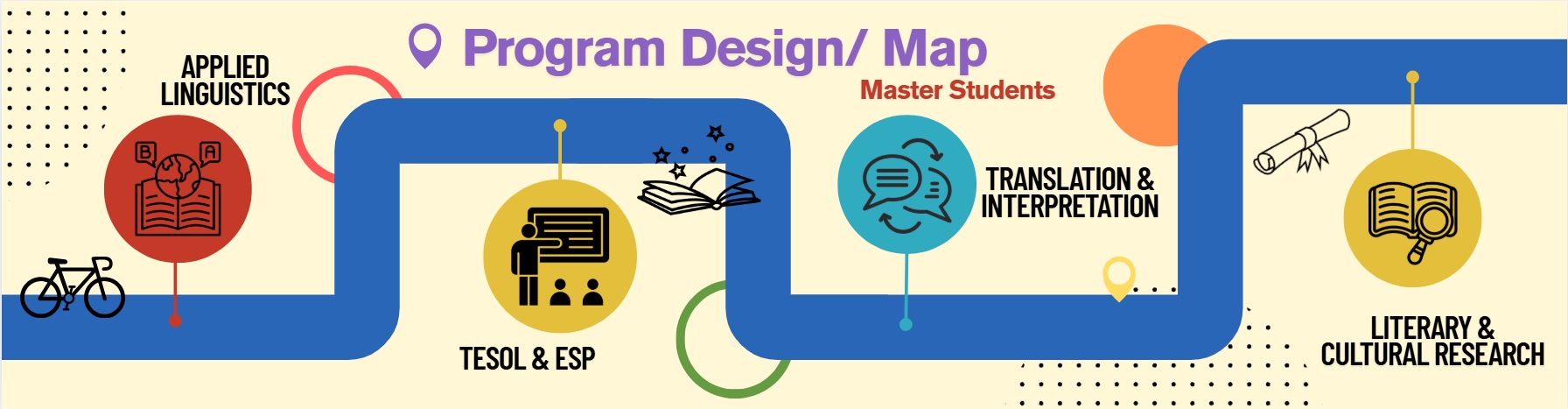
Our applied linguistics track develops students' core competencies in multiple areas. Students cultivate research skills, observational abilities, logical argumentation, and analytical thinking, all while enhancing their English communication proficiency. The curriculum emphasizes practical studies across diverse linguistic subfields and examines globalization's impact on language policy and planning. Through an integrated approach, students strengthen their understanding of global communication issues and develop advanced analytical capabilities. The required course of "Practical Studies in Applied Language" in our MA program focuses on professional language applications and emphasizes real-world implementation of linguistic theories.
The TESOL & ESP track addresses key global trends in language education. This track covers professional English language teaching, EMI research, and bilingual teaching methods. It also encompasses multimodal instructional design and classroom research on English language teaching and learning. Additional focus areas include language testing and assessment, with emphasis on technology-assisted language teaching innovations.
There have been many theses produced by our MA students in this field. One notable study examined verbal and non-verbal teacher-student interaction and student understanding in English teaching classrooms. Another research project, headed by our in-service MA student, investigated the impact of collaborative listening to podcasts on vocabulary learning among middle school students.
This track examines the evolving field of translation in the AI era. It focuses on understanding AI technology's impacts on the industry and modern teaching methodologies. Through professional translation training, students develop practical skills while analyzing media translation techniques and cross-cultural communication. These courses emphasize preparing translators who can adapt to rapid industry changes.
Our MA theses in interpretation and translation reflect our comprehensive approach. Recent studies include an analysis of Chinese translation strategies in Hollywood movie titles and their audience preferences. Another significant study evaluated the translation quality of multimodal texts in museums from a functionalist perspective. These projects demonstrate our commitment to bridging theoretical knowledge with practical applications.
This track integrates multiple disciplines to examine contemporary social and cultural issues. Through literary theory, cultural analysis, creative writing, and interdisciplinary research, students learn to address social concerns through literary creation. The track encourages students to respond to social changes through writing while analyzing theme, style, and cultural contexts. By combining perspectives from literature, history, politics, and gender studies, the program provides a rich, multifaceted approach to literary research. The required course of "Practical Studies in Literature and Culture" emphasizes multicultural applications and international communication through cultural studies.